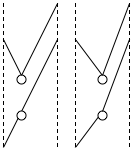
Block Sliding on String Makes Equal Angles
I wasn't completely confident that this was the case, even though it looked to be that way just from trying it out. In particular, I was concerned about whether this was perhaps only true if the two points it was hanging from were at the same height.
I tried to reassure myself through lots of crazy calculus, to no avail - it was a really tricky problem to approach analytically, in the general case. The proof finally occured to me on the bus ride home, an it's really cute and graphical, so I'll share it with you here for whoever's interested.
Take a look at the picture on the right. Two balls are shown, side by side, hanging down at the same height, from the same two end points. If the string segment on the left is flipped upside down in both, we get a new figure with the same length of string (shown under each). It is now clear that the left case is the shortest possible string that hangs a ball at that height, since it is a straight line in the transformed sketch. Therefore, to get that low with unequal angles is possible only with more string. Or, in other words, for any amount of string that hangs a ball somewhere with unequal angles, it is possible for it to fall down lower if the angles are equal.